

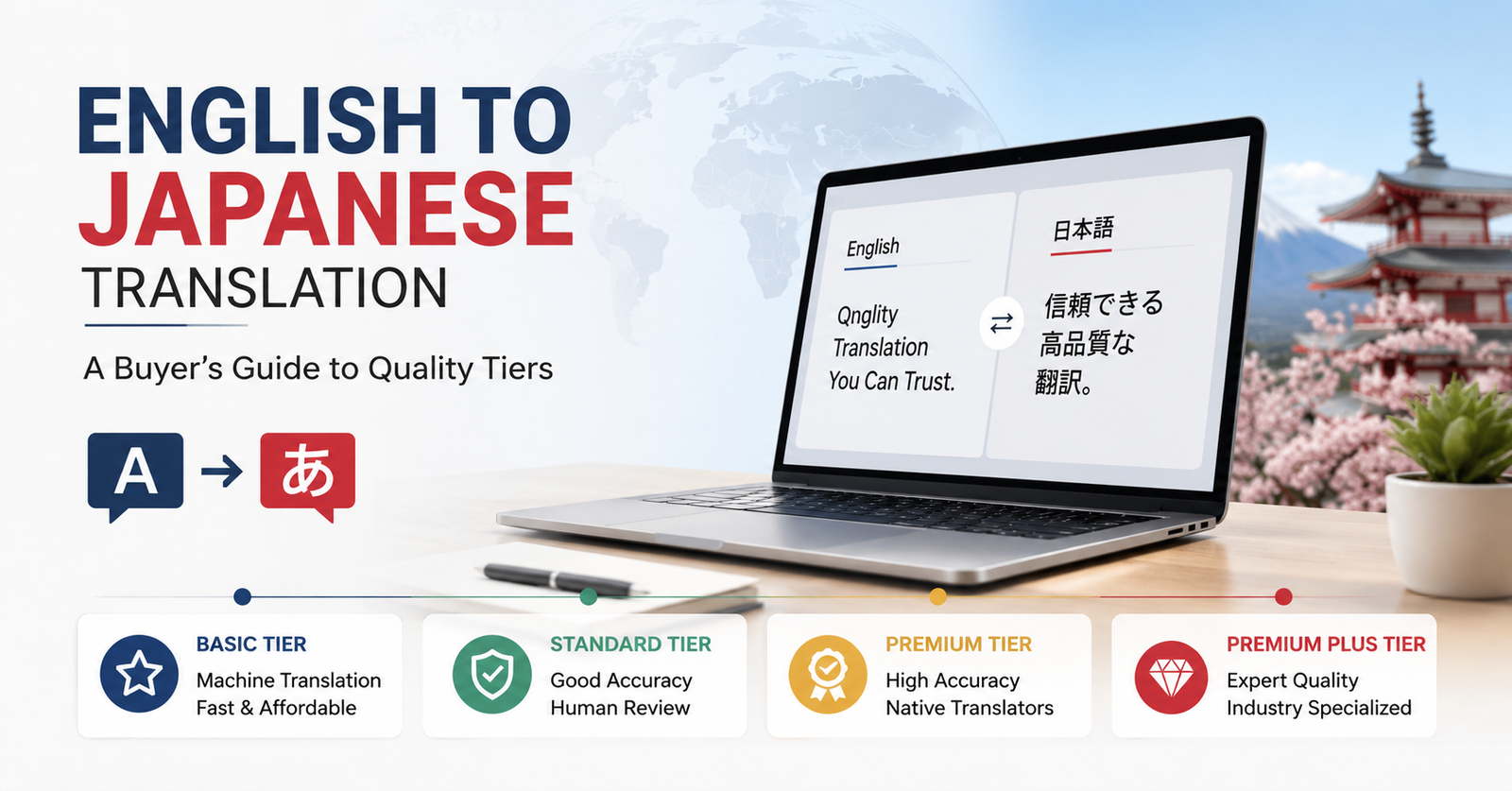
Choosing an English to Japanese translation provider can be difficult when different companies offer different prices, turnaround times, and levels of service. A low-cost quote may look attractive, but it may not include the same review process or specialist expertise as a premium service.
The right choice depends on what you are translating and how the final Japanese content will be used.
A product manual, legal document, website, marketing campaign, and internal email do not require exactly the same translation workflow. Understanding common quality tiers can help you compare providers more effectively.
Professional english to japanese translation services can range from basic translation to specialist localization with editing, proofreading, terminology management, and quality assurance.
What Does a Quality Tier Mean?
A quality tier describes the level of work included in a translation project.
There is no universal system that defines every tier. Different providers use different names.
A basic service may focus on translating the source text accurately. A higher-level service may include additional linguistic review and specialist localization.
Before comparing prices, ask exactly what each package includes.
Basic Translation
Basic translation is often suitable for content where the main objective is understanding.
Examples may include:
• Internal notes
• Simple emails
• General information
• Rough drafts
• Non-public documents
The translator converts the source content into Japanese while preserving the main meaning.
This option may be appropriate when the material does not need extensive stylistic adaptation.
Professional Translation
Professional translation generally involves a qualified translator working with the source material and project requirements.
This level may be suitable for:
- Business documents
- Product information
- Websites
- General reports
- Customer communications
The translator should understand the purpose and target audience rather than simply translating individual sentences.
Edited Translation
An edited translation adds another stage of review.
An editor checks the translated content against the source and looks for problems such as:
- Missing information
- Incorrect meaning
- Terminology inconsistencies
- Grammar issues
- Awkward phrasing
This can provide additional confidence for important business content.
Proofread Translation
Proofreading focuses on the final Japanese text.
A proofreader may check spelling, punctuation, formatting, grammar, and consistency.
Proofreading becomes especially useful when the content will be published publicly.
A website or brochure represents your company, so visible language errors can affect how professional the business appears.
Premium Localization
Localization goes beyond translation.
The content is adapted for Japanese users while preserving the original business objective.
This can involve:
• Tone
• Cultural context
• User expectations
• Marketing language
• Formatting
• Local terminology
Localization is often appropriate for consumer-facing content.
Marketing Translation Requires More Work
Marketing copy frequently contains slogans, wordplay, persuasive language, and cultural references.
A direct translation may preserve the words but lose the intended effect.
A higher-quality localization process considers how the Japanese audience will interpret the message.
The goal is to communicate the same marketing idea naturally.
Technical Translation Needs Subject Knowledge
Technical documents require terminology accuracy.
Examples include:
- Engineering manuals
- Software documentation
- Product specifications
- Manufacturing instructions
- Technical reports
A translator should understand the relevant terminology.
A glossary can also help maintain consistency across large projects.
Legal Documents Need Precision
Legal content requires careful handling because wording can affect meaning.
Contracts, agreements, policies, and other legal material should be translated by professionals familiar with the relevant terminology.
Depending on the document and its intended use, additional legal review may also be appropriate.
Translation should not be treated as a substitute for legal advice.
Certified Translation Is Different
Some documents may require certification or a specific form of official translation.
The requirements depend on the receiving organization and purpose of the document.
Before ordering a certified translation, confirm exactly what the recipient requires.
Do not assume that every agency’s standard translation will meet an official requirement.
Machine Translation Is Another Tier
Machine translation can be useful for understanding large amounts of content quickly.
It may work for internal reference material where perfect Japanese is not required.
However, public-facing or sensitive content can require human review.
Machine output may struggle with context, terminology, tone, and ambiguous Japanese or English expressions.
Human Review Adds Value
When comparing english to japanese translation services, ask whether human review is included.
A human translator or editor can identify issues that automated systems may miss.
This is particularly important for:
• Brand language
• Technical terms
• Cultural references
• Legal wording
• Customer-facing content
The required level of review should match the importance of the material.
Compare the Scope, Not Only the Price
Two agencies may quote different prices for apparently similar work.
The difference may come from the services included.
Compare:
| Service | Provider A | Provider B |
| Translation | Included | Included |
| Editing | Included | Extra |
| Proofreading | Included | Extra |
| Terminology management | Included | Not included |
| Formatting | Included | Extra |
| Localization | Included | Not included |
| Revisions | Included | Limited |
A higher quote may offer considerably more work.
Word Count Is Not the Whole Story
A 1,000-word technical document may require more specialist attention than a 1,000-word general article.
The complexity of the content can affect price and delivery time.
Consider:
- Subject matter
- File format
- Terminology
- Formatting
- Review requirements
- Deadline
These factors should be discussed before the project begins.
Ask About Translator Qualifications
Ask who will handle the translation.
Useful information can include:
- Japanese language expertise
- English proficiency
- Industry experience
- Translation experience
- Subject specialization
For technical or specialist projects, relevant experience may be more important than general translation experience.
Check Native Japanese Review
For content aimed at Japanese customers, native Japanese review can be valuable.
A reviewer can assess whether the content sounds natural and appropriate for the intended audience.
This is especially useful for marketing, websites, advertising, and customer support material.
Consider Terminology Management
Businesses often use specific words for products, services, departments, and features.
A quality translation process should account for these terms.
Ask whether the provider can create or follow a terminology glossary.
This becomes increasingly important when translating multiple documents over time.
Review Formatting Requirements
Translation can affect document layout.
Japanese text may change line lengths and page breaks.
If you need a finished brochure, presentation, catalogue, or formatted document, confirm whether formatting is included.
Otherwise, you may receive translated text that still requires additional design work.
Turnaround Time Can Affect Quality
Urgent projects may require additional resources.
If you need a large document translated quickly, ask how the agency plans to maintain quality.
A realistic provider should assess the word count, complexity, and review requirements before confirming a deadline.
Ask About Revisions
Find out what happens when you request changes.
Ask:
• How many revisions are included?
• What counts as a correction?
• Are terminology changes included?
• What happens if the source text changes?
Clear terms prevent disagreements later.
Check Confidentiality
Business translation can involve sensitive information.
Before sending documents, ask how the provider handles confidential material.
Important documents may contain:
- Contracts
- Product designs
- Financial information
- Customer data
- Business strategies
Understand who has access to the files and how they are stored.
Match the Tier to the Content
The best quality tier depends on your purpose.
For internal reference material, basic translation may be sufficient.
For an important business document, professional translation with editing may be more appropriate.
For a public marketing campaign, localization and native review may provide greater value.
For technical or regulatory content, specialist expertise and additional quality control may be necessary.
Do Not Pay for Unnecessary Services
Higher quality does not always mean adding every possible service.
If you only need to understand a private document, an extensive localization process may be unnecessary.
Explain how the translation will be used.
A good provider should help you select an appropriate workflow rather than automatically selling the most expensive package.
Request a Sample or Test Project
For a new provider, consider starting with a small assignment.
Review:
- Japanese quality
- Terminology
- Communication
- Delivery time
- Revision process
A small project can help you evaluate the provider before committing to a larger contract.
Build a Long-Term Process
Businesses that translate regularly can benefit from consistent processes.
Maintain:
• Translation memories
• Glossaries
• Style guides
• Approved product names
• Previous translations
These resources can improve consistency and reduce repeated work.
Make Your Requirements Clear
When requesting a quote, provide as much information as possible.
Tell the provider:
- Source language
- Target language
- Word count
- Document type
- Subject
- Intended audience
- Deadline
- Required quality level
A detailed brief helps agencies provide more accurate quotes.
Focus on the Final Purpose
The most important question is how the Japanese content will be used.
If customers will read it, natural language matters.
If engineers will use it, technical accuracy matters.
If a government organization will receive it, document requirements matter.
If the content supports a marketing campaign, localization matters.
Your purpose should determine the quality tier.
Choosing between different english to japanese translation services becomes easier when you understand what each service actually includes. Basic translation can work for simple internal content, while professional translation, editing, proofreading, and localization provide additional levels of review for more important material.
Do not compare agencies on price alone. Check translator qualifications, subject expertise, review procedures, terminology management, formatting, confidentiality, revisions, and delivery times.
The right tier is the one that matches the purpose of your content. A simple internal document may not require an extensive workflow. A public marketing campaign, technical manual, or important business document may require specialist translation and additional review.
Before hiring a provider, explain your requirements clearly and ask for a detailed quote. If possible, test the service with a smaller project first.
A well-planned translation process helps you spend your budget where it matters most. Instead of automatically choosing the cheapest or most expensive option, select the level of service that provides the accuracy, natural Japanese, and review your specific project requires.
