

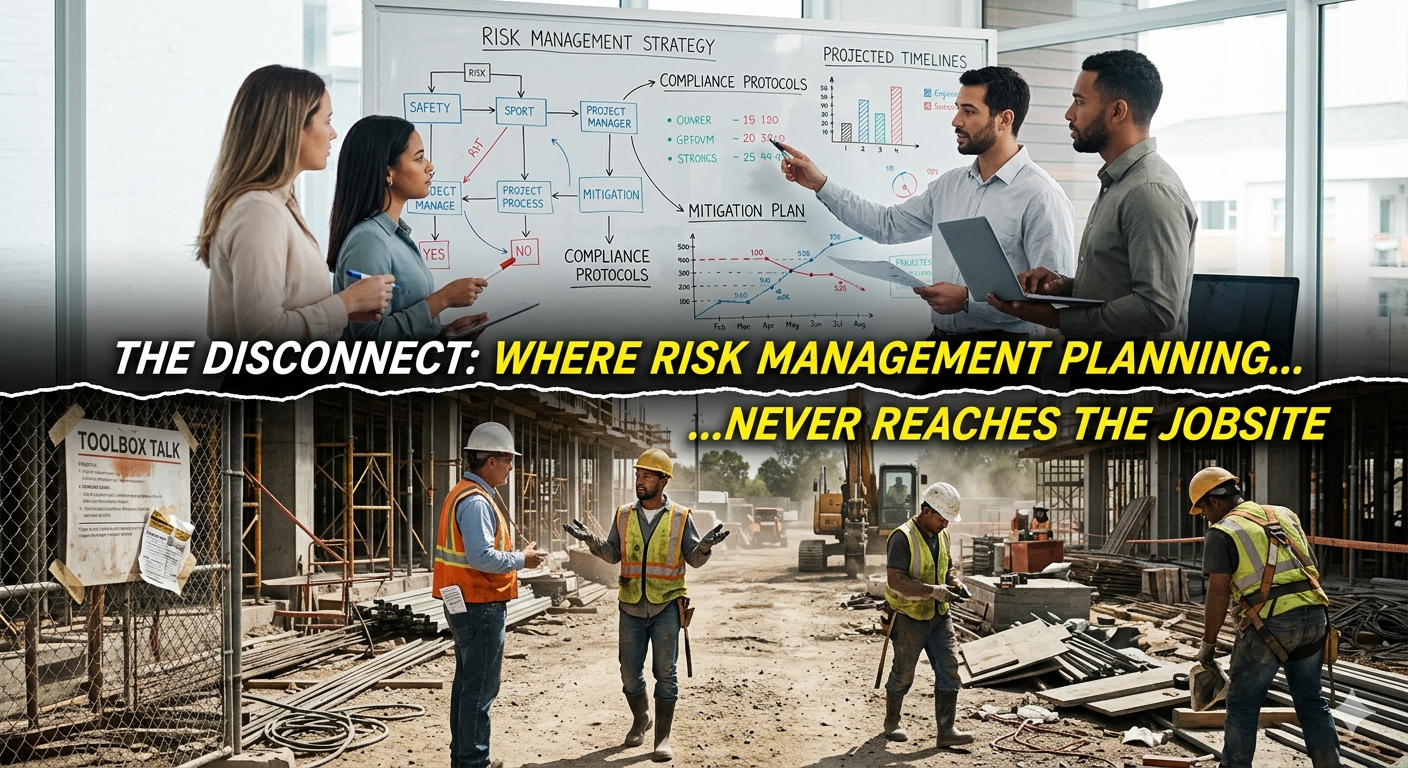
Construction risk management often looks strong on paper. Many companies have written safety policies, project protocols, inspection procedures, reporting systems, and pre-task planning requirements in place before work begins. But the existence of a plan does not mean risk is truly being managed. The real test is whether those safety measures are consistently carried through on the jobsite, where pressure, pace, and changing conditions can quickly expose gaps between policy and practice.
That gap is where many serious problems begin. A project may have clear documentation, designated responsibilities, and formal safety expectations, yet still experience preventable injuries when communication breaks down or site conditions change faster than oversight can keep up. Risk management fails when it becomes a paperwork exercise rather than an active part of daily operations.
This matters because construction hazards are rarely static. Site access changes, equipment moves, crews rotate, deadlines tighten, and multiple contractors may be working in the same space at the same time. Conditions that were reviewed at the start of the week may no longer reflect what workers face two days later. That is why broad policies alone are not enough. Effective safety management requires continuous attention, correction, and follow-through, along with adherence to established OSHA construction safety guidance.
One common problem is that safety planning often loses force once production pressure increases. Deadlines, inspections, deliveries, subcontractor coordination, and cost concerns can shift focus away from worker protection, especially when crews are trying to keep a project moving. In that environment, shortcuts become easier to justify. A missing barrier may be left unaddressed for the day. A temporary access route may remain in use longer than it should. A known hazard may be discussed without being corrected. These decisions may appear minor in the moment, but they can create serious exposure over time.
Another issue is the way responsibility gets fragmented across multiple parties. On many projects, owners, general contractors, subcontractors, site supervisors, and specialty crews all have some role in jobsite safety. But shared responsibility can easily become diluted responsibility if expectations are not reinforced clearly. One team may assume another is handling a hazard. A supervisor may identify a problem but rely on someone else to address it. A subcontractor may follow its own internal process without aligning fully with site-wide protocols. When that happens, important safety measures can fall through the cracks.
Even strong planning tools lose value if they are not tied to actual accountability. Daily checklists, safety meetings, hazard reports, and digital inspections are useful only when they lead to real correction. A company can document a problem repeatedly, but if no one acts on that information, the system becomes little more than a record of preventable failure. Risk
management is not effective because hazards are recorded. It is effective when hazards are resolved before someone gets hurt.
The consequences of those failures can be severe. Construction injuries often involve falls, struck-by incidents, equipment accidents, structural hazards, or unsafe site conditions that result in broken bones, head injuries, spinal trauma, crush injuries, or other long-term harm. For workers and their families, the effects can stretch far beyond the immediate incident. Lost income, surgery, rehabilitation, ongoing pain, and permanent limitations can change the course of a person’s life in ways no jobsite report can fully capture.
When serious injuries happen under those circumstances, the legal issues may also become more complicated. A worker may initially assume the event was simply part of a dangerous job, but deeper review can raise questions about site coordination, contractor oversight, hazard correction, or third-party negligence. In those situations, injured individuals may seek guidance from an Anchorage construction accident lawyer to better understand whether safety breakdowns on the project contributed to what happened.
The construction industry does not lack safety procedures. In many cases, it lacks reliable execution under real-world conditions. Risk management fails when planning stays in binders, checklists stay unchecked, and responsibility stays vague once work is underway. The companies that reduce injuries most effectively are not the ones with the most polished documents. They are the ones that make safety visible, enforceable, and active on the jobsite every day.
