

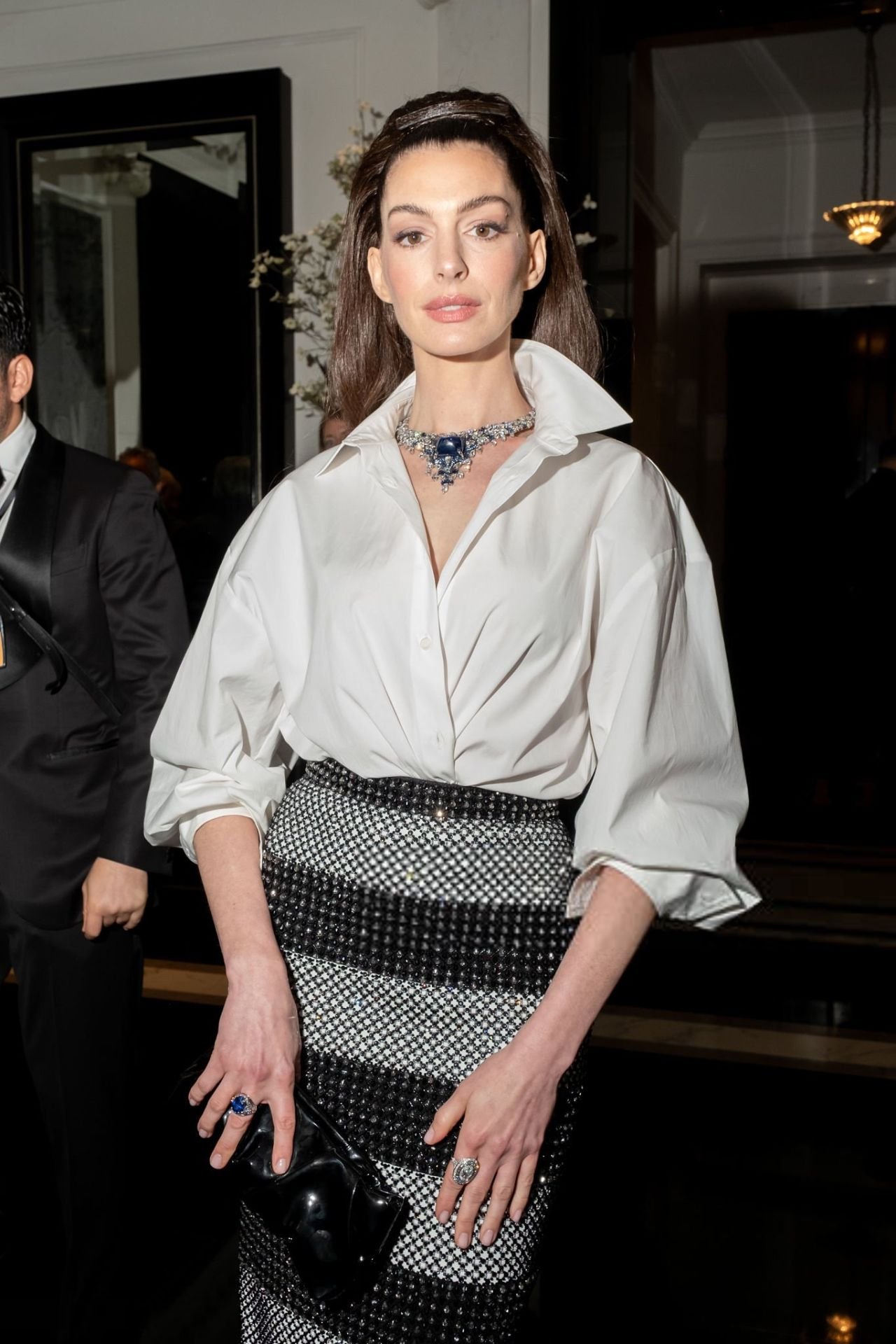
Anne Hathaway is one of the rare modern stars who can credibly do it all: broad comedy, prestige drama, musicals, action blockbusters, and glossy romance—sometimes within the same stretch of years. Her career has lasted long enough that multiple generations claim her as “their” Anne Hathaway: the awkwardly adorable new princess, the ambitious assistant navigating a ruthless fashion world, the heartbreaking Fantine, the sleek Catwoman, the scientist chasing impossible answers, and the red-carpet presence who can dominate a cultural conversation in a single photo.
What makes Hathaway particularly fascinating is not just how famous she is, but how strategically she’s built a career that stays flexible. She’s resisted being locked into one identity, and she’s continually recalibrated—moving between audience-friendly hits and challenging roles that demand craft and emotional risk. Alongside her acting work, she has also developed a public profile rooted in purposeful advocacy, including her role as a UN Women Goodwill Ambassador focused on gender equality and the unequal burden of unpaid care work.
This is a complete, long-form look at Anne Hathaway: her background, the defining phases of her filmography, her acting style and cultural impact, her fashion evolution, her public activism, and the projects that continue to keep her career in motion.
A brief profile: who is Anne Hathaway?
Anne Jacqueline Hathaway was born on November 12, 1982. She emerged in the late 1990s and early 2000s as one of the most promising young actresses of her era, and she quickly became a major Hollywood leading lady. Over the years, she has collected top-tier recognition—including an Academy Award, a BAFTA, a Golden Globe, and a Primetime Emmy—while her films have reached massive global audiences.
That combination—critical credibility and mainstream popularity—is hard to maintain over decades. Many actors end up with one defining “era” or a single iconic role. Hathaway has had several, and she has managed to keep adding new ones.
The breakthrough: becoming a princess (and refusing to stay one)
For many people, Anne Hathaway’s first big impression was as Mia Thermopolis in The Princess Diaries (2001): a shy teenager who discovers she’s the heir to a European throne. The film made her instantly recognizable. It was charming, fizzy, and designed to build a star, and it worked.
The industry loves when it can package a young actor into a predictable brand. After The Princess Diaries, Hathaway could have become a permanent “family film” fixture—forever playing earnest, wholesome characters with makeover arcs and happy endings. And she did return to that world for a time, including Ella Enchanted (2004), reinforcing her appeal to younger audiences.
But a career built only on that identity often narrows quickly. Hathaway’s next major move was to show she could carry adult drama and take on material that required more complicated emotional work.
The early pivot: stepping into serious films
One of the most important early “I’m not just the princess” statements came with Brokeback Mountain (2005), where Hathaway played the wife of one of the film’s central characters. The film’s reputation for emotional complexity and cultural impact gave her a new kind of credibility. It also signaled that she was willing to be part of stories that weren’t built around her star persona—stories that demanded maturity.
This pivot matters because it’s a pattern she repeats throughout her career: when the public begins to define her too narrowly, she changes the narrative through a role that stretches perception.
Pop culture cement: The Devil Wears Prada and the “Andy Sachs effect”
If The Princess Diaries made her famous, The Devil Wears Prada (2006) made her a pop-culture fixture.
As Andy Sachs, Hathaway played a smart, idealistic young woman who enters the high-pressure world of fashion journalism under the legendary, terrifying Miranda Priestly. The film is often remembered for its style and iconic lines, but Hathaway’s performance is what anchors it emotionally. Andy is not a helpless victim, and she’s not a caricature of naïveté. She’s competent, ambitious, and adaptable—yet deeply conflicted about what ambition costs.
That’s why the role stuck. Viewers saw themselves in her, regardless of whether they cared about fashion. The “Andy Sachs effect” is the way the character becomes a mirror: How much of yourself do you trade for success? When do you stop being “driven” and start being consumed?
The film’s long afterlife—memes, quotes, references, and constant rewatchability—only increases the importance of Hathaway’s contribution. A character doesn’t become that culturally durable unless the performance is emotionally legible and tonally nimble.
Growing up on-screen: drama, risk, and range
After establishing her mainstream appeal, Hathaway repeatedly sought roles that tested her. She alternated between lighter films and more demanding dramas, building a reputation for range.
What’s notable is that she didn’t simply pursue “serious” roles to prove a point. Instead, she pursued variety. She played romantic leads, comedic characters, and troubled figures. This variety protected her career long-term; she was never just one thing.
That strategy became especially clear in the 2010s, when she moved seamlessly between blockbuster scale and intense, awards-driven acting.
Blockbuster power: Catwoman and the art of being cool on purpose
When Hathaway was cast as Selina Kyle/Catwoman in Christopher Nolan’s The Dark Knight Rises (2012), the choice made a kind of sense and also surprised people. Catwoman is a role with heavy baggage: fans carry strong expectations, and comparisons are inevitable.
Hathaway’s Catwoman worked because she made the character sharp and self-possessed rather than overly stylized. Her performance balanced seduction, humor, danger, and practicality. She wasn’t playing “femme fatale cosplay.” She was playing someone extremely intelligent, highly adaptable, and always one step ahead—until the story forces her to reveal what she actually cares about.
The role also certified her as a blockbuster actor, someone who can handle spectacle without being swallowed by it.
The Oscar peak: Les Misérables and the power of total commitment
Also in 2012, Hathaway delivered the performance that became her defining awards moment: Fantine in Les Misérables.
Fantine is a role that can become melodrama in the wrong hands. Hathaway’s version was emotionally raw but structured; the suffering felt real because she grounded it in specific human choices rather than generalized sadness. Her performance of “I Dreamed a Dream” became a cultural reference point, frequently cited as a moment of total vulnerability and commitment.
The industry responded in a big way. Hathaway won the Academy Award for Best Supporting Actress, as well as a Golden Globe and a BAFTA for the role. That triple recognition matters because it signals both popular momentum and critical consensus.
Winning an Oscar can sometimes freeze an actor in place—turning them into “award winner” first and artist second. Hathaway used it instead as leverage to keep choosing widely different projects.
Holding the center in big ideas: Interstellar and emotional intelligence in sci-fi
Christopher Nolan’s Interstellar (2014) is one of those films that can overpower the human element with sheer concept: time dilation, cosmic scale, huge philosophical questions, massive imagery. In that environment, acting becomes about keeping the story emotionally grounded.
Hathaway’s performance helped do exactly that. She made the stakes feel personal and intimate even when the plot is dealing with the fate of humanity. In many sci-fi films, the human heart becomes a footnote. In Interstellar, her character helps keep the heart central. It’s a reminder that Hathaway’s skill isn’t just intensity—it’s emotional clarity.
Career longevity in the modern era: the 2020s and staying “current” without chasing trends
The 2020s have been a complicated decade for celebrity. The internet rewards constant presence, but constant presence can cheapen mystique. The industry has shifted toward franchises and IP, but audiences still crave actors who feel like real stars.
Hathaway has managed to navigate this by staying visible, but not overexposed. She appears in projects that keep her relevant, but she doesn’t turn every aspect of her life into content. She participates in modern culture while maintaining a sense that she’s still primarily an actor, not a full-time influencer.
This balance is part of what keeps her “movie star” aura intact.
Red carpet evolution: why Anne Hathaway is a fashion headline machine
Anne Hathaway’s relationship with fashion has evolved dramatically since her early “ingenue” years. In the 2000s, she was often styled in ways that emphasized classic prettiness and traditional glamour. Over time, her red-carpet choices became sharper, bolder, and more playful.
In recent years, she’s repeatedly become a viral fashion subject—partly because her looks are often clean, high-impact, and confidently executed, and partly because she carries them with a kind of self-assured ease. Whether it’s sleek tailoring, dramatic silhouettes, or high-glam Hollywood polish, she tends to look intentional rather than costume-y.
Her 2025 Met Gala appearance is one example of how she uses fashion as narrative. She wore Carolina Herrera and described the look as a tribute to the late André Leon Talley, connecting the outfit to fashion history rather than simply wearing something pretty. That kind of framing helps explain why she gets so much style coverage: the look becomes a conversation.
Advocacy and public identity: UN Women, care work, and gender equality
Hathaway’s activism has a consistent theme: gender equality, specifically through the lens of unpaid care work—the invisible labor of childcare and domestic responsibilities that disproportionately falls on women.
In 2016, UN Women announced Hathaway as a Goodwill Ambassador, highlighting her focus on how unequal care burdens hold women back economically and socially. This is a policy-adjacent issue, not just a feel-good slogan. It connects to workplace equality, parental leave, childcare access, and broader economic participation.
In a world where celebrity activism can sometimes feel vague, Hathaway’s approach stands out because it is specific. She advocates around systems, not just sentiments. That specificity makes the message more durable and credible, and it fits with her broader public persona: thoughtful, articulate, and intentional.
Personal life: privacy as a modern strength
Anne Hathaway married Adam Shulman in 2012, and they have two children. While the basics are public, she has generally kept her family life relatively private compared with many celebrities.
This privacy is not accidental. It’s a choice that functions like career strategy: it protects her ability to be seen as a performer first. Audiences can still project onto her characters because her real life isn’t constantly competing for attention.
In the modern celebrity economy, where access often equals currency, withholding access can actually be a form of power.
What makes Anne Hathaway a great actor?
Plenty of actors have talent. Not many sustain relevance across decades. Hathaway’s craft has a few recurring strengths that help explain her longevity.
1) Emotional precision
Even when she goes big—especially in musicals or heightened drama—her performances tend to be structured. Emotion doesn’t appear randomly; it arrives as consequence. This prevents her most intense roles from becoming messy or indulgent.
2) Tonal adaptability
Hathaway can jump between genres because she understands tone. Comedy requires rhythm and restraint. Drama requires vulnerability. Blockbusters require clarity and presence. Musicals require emotional conviction that can survive heightened form. She adjusts without feeling like she’s acting in a different movie than everyone else.
3) The “audience bridge” factor
In huge films, someone has to hold the viewer’s hand emotionally. Hathaway is often that person. She makes big stakes feel personal and comprehensible.
4) Willingness to be unglamorous
A lot of stars protect their image. Hathaway has repeatedly chosen roles that risk making her look exhausted, desperate, awkward, or raw. That risk is part of why audiences trust her. The performance comes first.
Essential Anne Hathaway viewing: a practical watch list
If you want to understand her range without watching everything, this is a simple starter kit:
- Star-making charm: The Princess Diaries
- Comedy + cultural icon status: The Devil Wears Prada
- Prestige credibility: Brokeback Mountain
- Blockbuster authority: The Dark Knight Rises
- Oscar-winning intensity: Les Misérables
- Sci-fi gravitas: Interstellar
This set gives you a clear view of her evolution from youthful star to versatile powerhouse.
What’s next: the upcoming chapter
One of the most interesting things about Hathaway right now is how busy her future slate appears. It includes sequels, thrillers, and epic filmmaking—suggesting she’s continuing her long-running pattern: mixing familiar IP with fresh challenges.
Reported upcoming projects into 2026 include:
- A sequel to The Devil Wears Prada, with major returning cast members expected.
- A psychological thriller adaptation of Verity (based on the popular novel).
- A continuation of The Princess Diaries in development.
- Christopher Nolan’s The Odyssey, a large-scale adaptation of Homer’s epic with a high-profile ensemble.
- Other films in the pipeline that keep her in the mix across genres.
Whether every listed project lands exactly as scheduled is always subject to industry changes, but the shape of the slate is the point: Hathaway is positioning herself for another multi-year run of cultural visibility.
The real takeaway: why she still matters
Anne Hathaway career is proof that stardom isn’t just talent—it’s choices.
She made early fame work for her without letting it define her. She took risks at moments when staying safe would have been easier. She built credibility through challenging roles, then used that credibility to keep experimenting. She maintained a public image that supports her work rather than replacing it. And she continues to be one of the few actors who can move between prestige and mass appeal without seeming out of place in either world.
That’s why she remains compelling: she’s not stuck in nostalgia, and she’s not chasing relevance. She’s simply continuing to evolve, with enough craft to make each evolution feel earned.
Anne Hathaway isn’t just a star from a certain era. She’s a star who keeps finding new eras to belong to.
