

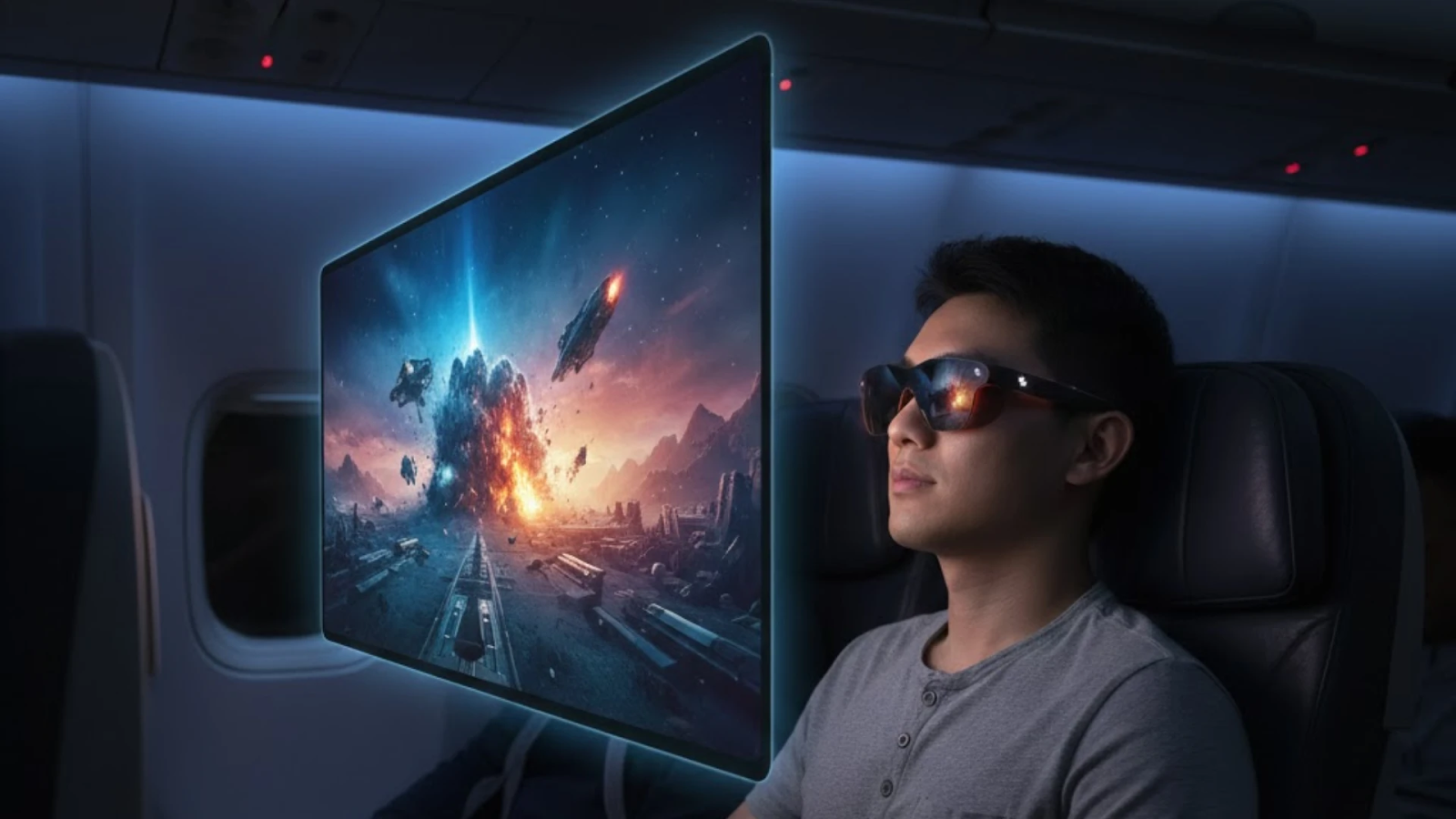
Watching a movie on your phone sounds fine until you actually try it for two hours on a plane. The screen feels tiny, the brightness washes out under cabin lights, and the passenger beside you gets a free screening. In 2026, smart glasses built for media playback are offering a different path forward.
The RayNeo Air 4 Pro is one of the most discussed options in the growing category of AR glasses for movie watching. With an MSRP of $299, HDR10 support, and a 201-inch virtual screen, it aims to turn any compatible device with DisplayPort-enabled USB-C into a portable cinema.
But does the real-world experience match the marketing? Here is a closer look at what this device delivers, where it falls short, and how it compares to other options.
Why Your Phone Still Falls Short for Movies
Even the largest flagship phones top out around 6.9 inches. Play a widescreen film in 2.39:1 aspect ratio and the visible image area shrinks significantly — thick letterbox bars eat into the already limited screen, leaving you with a narrow viewing strip. Dark scenes and wide landscape shots lose detail fast.
Tablets offer more screen real estate, but they add another device to carry and charge. Portable projectors need a dark room and a flat surface. Smart glasses promise to solve both problems at once — a big virtual display that fits in a glasses case and works anywhere.
The question is whether any pair of AR glasses for movie watching has matured enough to justify the purchase over simply tolerating a small screen. That is exactly the promise the RayNeo Air 4 Pro is making, and it is worth a closer look.
What the RayNeo Air 4 Pro Does Differently
The Air 4 Pro connects to a phone, laptop, or console through a single USB-C cable. It mirrors the source display onto dual micro-OLED panels sitting in front of each eye, producing what RayNeo describes as a 201-inch virtual screen at six meters. Several smart glasses now target media viewers, but this model differentiates itself in three areas.
HDR10 Micro-OLED Display
RayNeo claims these are the world’s first HDR10 AR display glasses. The dual SeeYa 0.6-inch micro-OLED panels deliver 1,200 nits of peak brightness, a 120Hz refresh rate, and 98 percent DCI-P3 color coverage. In a CES 2026 hands-on demo, Mashable described the display as “surprisingly crisp, bright, and colorful” compared to the Xreal One Pro the reviewer had been testing.
Bang & Olufsen Audio
Four directional speakers co-tuned with Bang & Olufsen handle audio without the need for separate earbuds. Gizmodo noted the sound felt “full and immersive despite the relatively small form factor.” The open-ear design keeps you aware of your surroundings, which matters on flights and public transit.
AI-Driven Visual Features
A Pixelworks Vision 4000 chip powers two notable features:
- AI HDR upscaling, which converts standard SDR video to HDR in real time
- 2D-to-3D conversion for photos and compatible video content (Xreal’s lineup also offers 2D-to-3D, so this is not unique to RayNeo)
Gizmodo tested the 3D conversion and described it as “better than expected,” especially with content originally captured on phones. The AI HDR upscaling works best on 1080p sources; Gizmodo noted that upscaling 480p content produced only marginal improvement.
It is also worth noting that Gizmodo found some features underwhelming. The color enhancement mode is SDR-only, and the Mirror Studio secondary display feature was described as “incredibly blurry” in testing — a software issue RayNeo may address in future updates.
What the Experience Actually Feels Like
Specs tell part of the story, but the more useful question is how these AR glasses for movie watching perform during a real two-hour viewing session. Hands-on reviews from multiple outlets offer a consistent picture of both strengths and trade-offs.
Setup and Compatibility
Getting started takes seconds on devices that support DisplayPort over USB-C. Plug in the included cable, and the display mirrors automatically — no app or driver needed for basic use. Gizmodo confirmed this worked instantly with an iPhone 17. Note that not all USB-C phones support DP output; check the official compatibility list. Compatible devices include:
- iPhone 15 and later models with USB-C display output (RayNeo excludes iPhone 16e from full HDR support), plus Samsung Galaxy S-series and select Android flagships with DP Alt Mode
- MacBooks, iPads, and Windows laptops with USB-C DisplayPort
- Steam Deck, ROG Ally, and Legion Go handheld consoles
Comfort, Fit, and Power Draw
At 76 grams, the Air 4 Pro weighs about as much as a pair of thick sunglasses. ZDNet found the weight distribution balanced during testing. Gizmodo’s reviewer, however, flagged that the nose bridge fit may not suit all face shapes. Larger nose pads are included in the box, and the arms snap into three positions for adjustment.
Battery drain deserves attention. These smart glasses draw power from the connected device, not an internal battery. Gizmodo measured roughly 4 percent battery drain per 10 minutes on an iPhone 17 at full brightness and 120Hz. A two-hour movie could consume nearly half a phone’s charge, so keeping a power bank nearby is practical.
How It Compares to Other Viewing Options
The real test for any pair of AR glasses for movie watching is not just absolute quality — it is whether the experience beats the alternatives a buyer already has. Here is where the Air 4 Pro lands relative to other common mobile viewing methods and competing smart glasses.
Side-by-Side Comparison
| Feature | Phone (6.7″) | Tablet (11″) | RayNeo Air 4 Pro | Xreal 1S |
|---|---|---|---|---|
| Screen Experience | 6.7″ panel | 11″ panel | 201″ virtual (per RayNeo) | Large virtual screen |
| HDR Support | Varies | Varies | HDR10 | No HDR10 |
| Spatial Display | N/A | N/A | Limited | Yes (X1 chip, 3DoF) |
| Audio | Phone speaker | Tablet speaker | B&O quad speakers | Built-in speakers |
| Privacy | Low | Low | High | High |
| Price (MSRP) | Already owned | $350–$1,100 | $299 | $449 |
Where the RayNeo Air 4 Pro Has an Edge
HDR10 support is the clearest differentiator. Based on official product materials available as of early 2026, RayNeo is the only brand explicitly marketing HDR10 in its AR glasses for movie watching — Xreal, Viture, and Rokid do not list it in their current spec sheets. In a CES hands-on demo, Mashable’s reviewer noted the display quality difference was “immediately noticeable” compared to the Xreal One Pro, though that impression came from a brief demo rather than extended side-by-side testing.
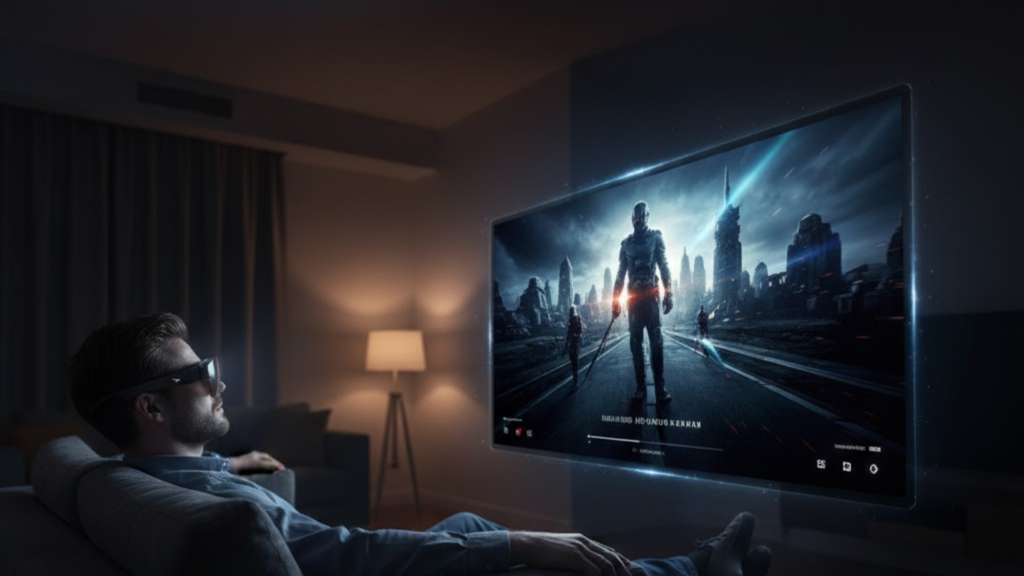
Pricing also works in its favor. At an MSRP of $299, the Air 4 Pro undercuts the Xreal 1S by $150. For buyers focused on movie quality, the combination of AR glasses for movie watching with HDR10, B&O audio, and real-time SDR-to-HDR upscaling is hard to match at this price. The Xreal 1S, however, offers spatial display features via its X1 chip that the Air 4 Pro lacks.
Where Other Options Hold Up
Other smart glasses in the display category have their own strengths. Xreal’s higher-end One Pro offers a larger field of view and adjustable virtual screen positioning, features that may matter more for productivity and gaming than for passive movie watching. Tablets still win for simplicity, shared viewing, and not needing a tethered source device. AR glasses for movie watching remain a strictly solo experience tied to a compatible host device.
What Could Be Better
No product is without trade-offs, and AR glasses for movie watching are still a maturing category. The Air 4 Pro has clear areas where the next generation could improve, and being upfront about these helps set realistic expectations.
Key Limitations
Resolution stays at Full HD per eye. For most streaming content this is adequate, but viewers accustomed to 4K displays may notice softer detail. Gizmodo reported slight blurriness near the edges, likely tied to individual nose bridge fit — a limitation shared by most smart glasses in this form factor.
HDR10 output also requires a compatible source device. Most Android phones do not support 10-bit video over DisplayPort, so the full HDR advantage is currently limited to iPhones, Macs, PCs, and select consoles. Key areas that would benefit from improvement include:
- An internal battery for untethered viewing sessions longer than a phone charge allows
- Higher resolution panels to match the HDR10 color quality with sharper fine detail
- More adjustable nose bridge options for a wider range of face shapes
Final Take
For frequent flyers, commuters, and anyone tired of squinting at a phone screen, the RayNeo Air 4 Pro is one of the most compelling AR glasses for movie watching available today. It is not perfect — fit varies, HDR10 needs a compatible source, and resolution could be higher — but at $299 MSRP with HDR10 and B&O audio, it makes a strong case for portable cinema in 2026.
