

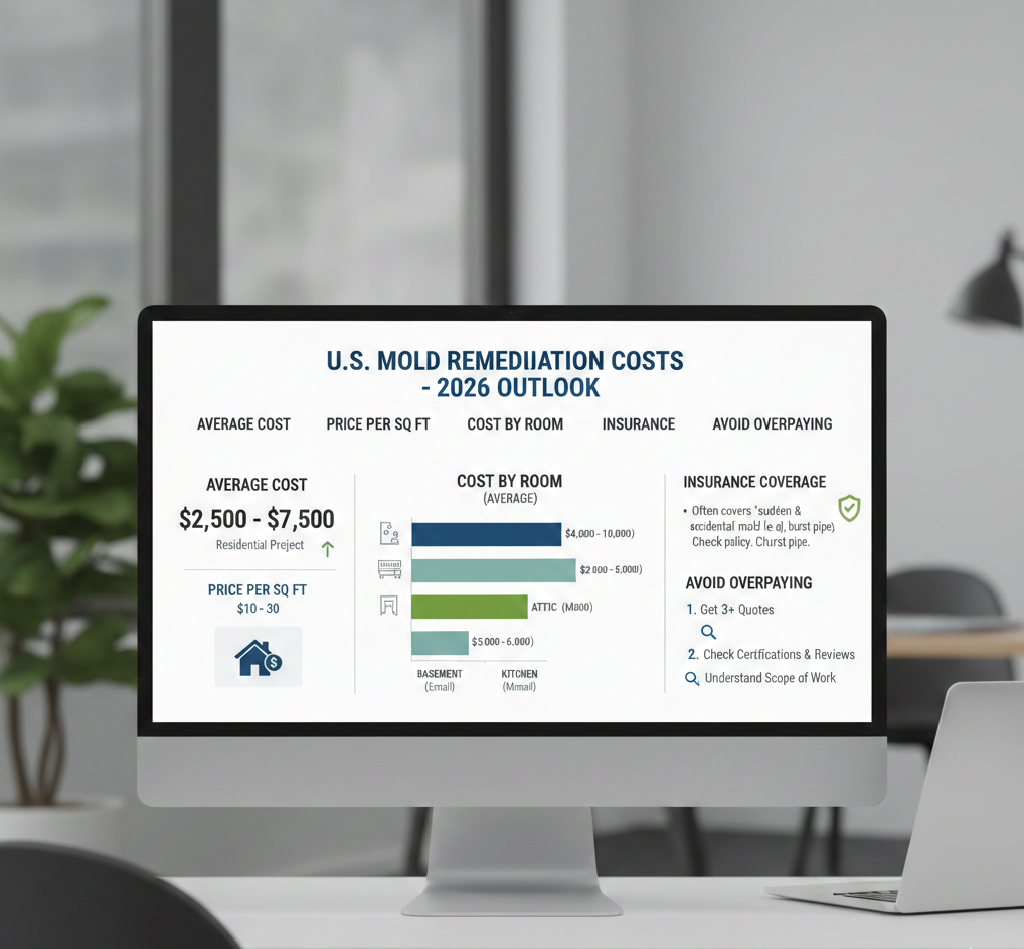
Mold usually isn’t “just a stain.” It’s a moisture problem that shows up on surfaces, inside walls, in attics, crawl spaces, and sometimes in HVAC systems. That’s why mold remediation pricing in the U.S. can feel confusing: one home might need a simple clean-and-treat job, while another requires containment, air filtration, removal of drywall/insulation, and repairs after the source of moisture is fixed.
This guide breaks down typical mold remediation costs in 2026, what affects the price, what you should ask before you hire a pro, and how insurance may (or may not) help.
Average mold remediation cost in 2026
In the U.S., most homeowners spend around $1,200 to $3,750, with a common average near $2,300–$2,400.
Many companies also estimate by size, typically charging about $10 to $25 per square foot depending on severity and access.
Quick cost table (easy ballpark)
| Situation | Typical Cost Range |
|---|---|
| Small area (minor growth) | $500–$1,500 |
| Most common homeowner jobs | $1,200–$3,750 |
| Pricing by size (per sq ft) | $10–$25/sq ft |
| Large / severe / multi-room cases | $10,000–$30,000 |
Big takeaway: price goes up fastest when mold is hidden (walls/attic/crawl space) or when materials must be removed and rebuilt.
What you’re actually paying for
A professional remediation plan may include:
- Inspection & scope (sometimes separate line-item)
- Containment (plastic barriers and negative pressure to prevent spore spread)
- HEPA filtration (air scrubbers)
- Removal of contaminated materials (drywall, insulation, carpet, baseboards)
- Cleaning + antimicrobial treatment
- Drying/dehumidification (to stop regrowth)
- Disposal + cleanup
- Optional: post-remediation verification (clearance testing)
If a quote sounds “too cheap,” it may be missing containment, air filtration, or removal/disposal—these are often the difference between a temporary cleanup and a real remediation.
Key factors that change mold remediation pricing
1) Total size of the affected area
As a practical guideline, the EPA categorizes mold cleanup by total area: small jobs are under about 10 sq ft, medium 10–100 sq ft, and large 100+ sq ft.
More area = more labor, more equipment time, and usually more containment.
2) Where the mold is located (access matters)
Mold in open areas is cheaper than mold in:
- behind drywall
- under flooring
- inside attics
- in crawl spaces
- inside HVAC systems
The harder the access, the more demo and rebuild can dominate the bill.
3) Porous vs non-porous materials
Non-porous (tile, metal, sealed surfaces) can sometimes be cleaned. Porous materials (drywall, carpet, insulation) often require removal, disposal, and replacement—this is where costs jump.
4) Fixing the moisture source
Remediation without stopping the moisture is money wasted. Sometimes the fix is small (bath fan upgrade); sometimes it’s bigger (roof leak, plumbing leak, crawl space moisture control). Plan a separate budget for the “why.”
5) Testing/clearance
Some homeowners choose final testing after remediation—especially after large jobs or if someone in the home is sensitive to allergens. It’s optional, but it adds credibility and peace of mind.
Mold remediation cost by room (typical scenarios)
These are not “guaranteed prices,” but common patterns:
- Bathroom (surface-level growth): often stays on the lower end if caught early
- Basement mold: can be moderate to high if humidity + hidden areas exist
- Attic mold: often tied to ventilation issues; removal may require working around insulation
- Crawl space mold: moisture control/encapsulation may be needed to prevent repeat problems
- HVAC mold: more complex because spores can spread through the system
If you’re writing multiple posts, you can make “spin-off” articles like Basement Mold Removal Cost and link them internally.
DIY vs hiring a professional
If the affected area is small (often framed as under ~10 sq ft), homeowners can sometimes handle it safely with proper precautions.
You should strongly consider a pro if:
- the area is larger than ~10 sq ft
- mold is inside walls/ceilings
- you can smell mold but can’t find it
- HVAC/ductwork might be involved
- mold keeps coming back (moisture source still active)
Does homeowners insurance cover mold remediation?
Sometimes—but often with limitations.
Many insurers won’t cover mold unless it’s the result of a covered peril (for example, sudden accidental water damage) and even then coverage may be capped or require specific endorsements.
Before you spend money, call your insurer and ask:
- Is this cause covered?
- Is there a mold limit?
- What documentation is required (photos, mitigation steps, invoices)?
How to avoid overpaying (without cutting corners)
Get 2–3 quotes and compare scope
Price alone isn’t enough. Compare:
- containment method
- HEPA air scrubber use + duration
- what materials will be removed
- disposal included or not
- moisture source fix included or separate
- timeline and warranty/guarantee (if any)
Ask these 7 questions before hiring
- What exactly is included (containment, filtration, disposal)?
- What will be removed vs cleaned?
- How do you prevent cross-contamination?
- Will you run negative air/air scrubbers? For how long?
- Who fixes the moisture source?
- Do you recommend third-party clearance testing?
- Are rebuild/repairs included or separate?
FAQs (schema-friendly)
How much does mold remediation cost per square foot?
Many contractors price remediation around $10 to $25 per square foot, depending on severity and access.
Is mold remediation worth it?
Yes—because mold usually signals a moisture problem. Proper remediation removes contaminated materials, cleans safely, and helps prevent spread and regrowth.
How long does mold remediation take?
Small jobs can take 1–2 days, while multi-room jobs may take a week or more depending on drying time, containment, and rebuild work.
Can I do mold remediation myself?
Small areas (often under ~10 sq ft) can sometimes be handled safely with proper precautions, but bigger or hidden problems should be handled by professionals.
Does homeowners insurance cover mold?
It depends on the cause and your policy. Mold is sometimes covered if it results from a covered peril, but coverage is often limited.
