

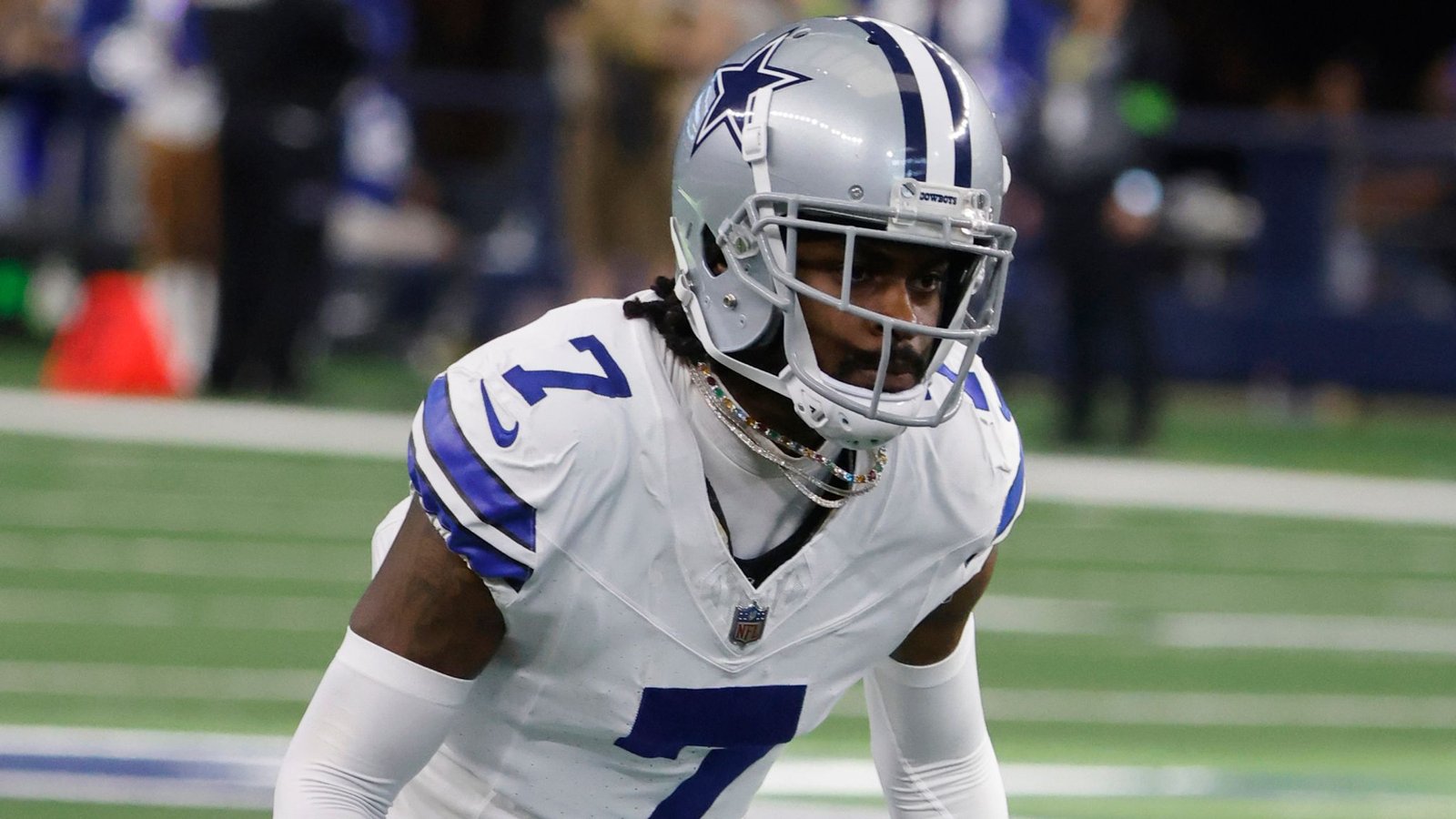
Trevon Diggs is one of the easiest NFL defenders to summarize in a single sentence—and one of the hardest to evaluate honestly.
The easy sentence: he’s a playmaking corner who can flip games with interceptions.
The hard part: the exact things that make him special also create the volatility that drives fans and analysts into endless arguments.
Some cornerbacks win by erasing wide receivers snap after snap, keeping everything in front, forcing incompletions, and living quietly in the background. Diggs doesn’t play that way. He plays like he’s trying to end the possession. He reads the quarterback, anticipates concepts, and attacks throws. When it works, you see it immediately—highlight reels, pick-sixes, momentum swings, stadium energy changing in a heartbeat. When it doesn’t, opponents can punish him with double moves and explosives, and suddenly the same aggressiveness looks like a gamble.
That is the Diggs experience: high impact, high variance, high scrutiny.
This article is a complete, standalone deep dive into Trevon Diggs—his background, how he became this type of corner, what his “ball-hawk” style actually is (and isn’t), why he polarizes people, how injuries complicate the evaluation, and what a realistic “best-case” and “most-likely” version of Diggs looks like going forward.
The origin story that explains everything: “receiver brain” in a cornerback body
If you want to understand why Trevon Diggs plays the way he does, start with the simplest but most meaningful fact about his football identity:
He didn’t grow up as a cornerback first.
His development included significant time as a receiver before he became a defensive back at the highest level.
That matters because corners and receivers are trained to think about the same routes from opposite directions. Receivers are taught to create separation and manipulate leverage; corners are taught to deny it and stay disciplined. When a player has lived both lives, he often sees route combinations differently. He may recognize stems, pacing, and route “tells” sooner than a corner who only ever learned defense.
This is why Diggs often looks like he’s “reading minds.” A lot of his biggest plays don’t come from running faster than someone. They come from recognizing what’s about to happen—anticipating a dig, a glance route, a comeback, or a late-breaking out—and beating the receiver to the spot.
But the receiver background doesn’t only create positives. Receivers are rewarded for risk. They try things. They improvise. They bait defenders. Translating that mentality to corner is what creates Diggs’ superpower…and the criticism.
Because the moment you play corner with receiver instincts, you’re more likely to:
- jump routes
- take calculated chances based on film tendencies
- turn your eyes to the quarterback earlier than the “textbook” DB technique demands
And if your read is wrong—even once—the punishment can be 30 yards downfield.
The breakout that made him famous: why “ball-hawk” isn’t just a label
Every few years, an NFL corner produces a season that changes how people talk about defense. Diggs did that early in his career, and the aftershocks never stopped.
When Diggs racked up interceptions at an elite rate, he became a symbol of something fans love: defense that doesn’t just stop you, but steals from you.
Interceptions are different from most defensive stats. A tackle is useful, but often it means the offense already succeeded in getting the ball somewhere. A pass breakup is a win, but it’s still “just” a stop. An interception is a theft. It ends the drive immediately, swings field position, and often changes the entire game plan.
So when Diggs hit that rare “too many picks to ignore” level, he became:
- a weekly storyline
- a defensive face of the franchise
- a lightning rod for debates about what cornerback play “should” be
And those debates typically split into two camps:
Camp A: “Turnovers are king”
This camp argues that the point of defense is to win possessions. If Diggs can take the ball away, he is creating value that can’t be replicated by a corner who’s merely solid. A defense built to generate turnovers is a defense that can beat better offenses.
Camp B: “Give me consistent, boring excellence”
This camp argues that a corner’s job is to erase and eliminate explosive plays. Interceptions are great, but if you give up too many big plays chasing them, you are trading certainty for gambling. A corner who consistently forces incompletions and prevents explosives may be more valuable over a season than a corner who swings wildly between highlight and heartbreak.
Diggs is the rare player who forces you to take a stance, because he represents a philosophical choice about defense. He isn’t just a corner. He’s a style.
What Trevon Diggs is, technically: a corner who plays the quarterback
A lot of people describe Diggs as a “gambler,” but that word is too lazy to be accurate.
A true gambler plays without structure. Diggs isn’t freelancing randomly. At his best, he is doing something very specific:
He is playing the quarterback as much as he is playing the receiver.
That means:
- reading dropbacks and shoulders
- identifying route concepts from formations and splits
- recognizing timing windows (when the throw is supposed to happen)
- understanding where the “conflict defender” is and how offenses want to stress the coverage
In many coverage schemes, a corner’s technique changes based on:
- down and distance
- whether there’s safety help inside or over the top
- the pass rush plan
- whether the defense is in man, zone, match, or a disguised rotation
Diggs thrives when the scheme either:
- gives him permission to be aggressive, or
- protects him if he misses.
That’s why his best stretches often correlate with:
- a strong pass rush that forces hurried decisions
- safety rotations that close the “oh no” space behind him
- a defense that expects volatility and is willing to live with it
He is not simply guessing. He is reading and driving. The problem is that reading and driving is inherently a risk, because the NFL is built to punish certainty.
Offenses know defenders study. So they build:
- double moves
- layered concepts
- “same picture, different route” variations
And the more famous you are for jumping routes, the more the offense will test your eyes.
Why Diggs gives up big plays sometimes—and why it doesn’t automatically mean he’s “bad”
Let’s be blunt: yes, Diggs can give up chunk plays. That’s part of the file on him. But here’s what gets lost in the noise:
1) Some big plays are the cost of being targeted
When a corner becomes famous, quarterbacks and coordinators do two different things:
- they avoid him entirely (which can reduce interceptions), or
- they attack him with specifically designed counters (which can create explosives)
With Diggs, teams often did the second. They wanted to punish his aggressiveness.
If you throw at a corner enough, two things happen:
- his interception opportunities increase
- his “bad moments” become more visible
High-variance corners look worse on a lowlight reel because they are frequently involved in the most dramatic outcomes.
2) Cornerback is a “no-context” position for casual stats
Fans see:
- interceptions
- touchdowns allowed
- yards allowed
But cornerback performance depends on context:
- Did he have safety help?
- Was it a scramble drill?
- Was it a busted coverage elsewhere?
- Was the route designed to stress a matchup that the defense knew was risky?
- Was he asked to play aggressive leverage because the call demanded it?
A corner can “lose” a play because the defense traded one risk for another. Diggs often plays in systems that encourage aggressive playmaking. That is not the same thing as random freelancing.
3) The NFL doesn’t reward passive corners with headlines
A corner who forces the quarterback to never throw his way might be elite. But it’s hard to prove to the average viewer. A corner who picks off passes creates visible, undeniable impact. Diggs’ style is more visible, and visibility increases both praise and blame.
What Diggs does exceptionally well
When you break down Diggs at his best, the traits aren’t mysterious. They’re specific and repeatable.
Elite ball skills
Diggs tracks the ball like a receiver. He doesn’t just swat—it’s common to see him:
- locate early
- time his hands
- play through the catch point
Many corners can stay in phase; fewer can finish. Diggs finishes.
Anticipation on in-breaking routes and timing throws
A lot of interceptions come on routes that are meant to be “safe” because the ball is delivered on schedule:
- quick outs
- slants and glance routes
- digs and intermediate in-breakers
- late-breaking patterns designed to exploit zones
Diggs’ best plays often come when he recognizes the concept early and drives on the intended window, arriving at the exact moment the quarterback expects the receiver to be open.
Size and length that helps him recover
If Diggs is slightly late, his length can still close space. That matters because “break” moments in the NFL are measured in fractions. His frame gives him a margin that smaller corners don’t always have.
Confidence that fuels playmaking
Some defenders are technically sound but hesitant. Diggs isn’t hesitant. He trusts his reads. That confidence is essential for interceptions because the window to jump a route is tiny. If you hesitate, you don’t pick it—you just watch it get completed.
Where Diggs can be stressed by offenses
Even elite corners have weaknesses, but Diggs’ vulnerabilities are tied directly to his style.
Double moves and eye discipline
If you are famous for driving hard on routes, offenses will build “show you something, then go” plays:
- sluggo (slant-and-go)
- out-and-up
- stutter-go variations
- post-corner and corner-post patterns that punish aggressive leverage
The goal isn’t only to beat Diggs physically. It’s to beat him mentally by forcing him to commit early.
Tackling and “run support” scrutiny
When a corner is a star, everything gets magnified—including tackling effort and technique. Diggs has had stretches where tackling becomes a discussion point, especially when teams isolate him with perimeter runs or quick screens.
To be fair: tackling is hard, and cornerback tackling is often thankless. But if you want to be the kind of star Diggs is, you don’t get to opt out of that part of the job, because offenses will make it your problem.
Volume of responsibility
Top corners get the opponent’s best and most creative game plans. The more you’re targeted with intention, the more your “weaknesses” are put under a microscope.
Diggs’ value isn’t just “coverage”—it’s how he changes an offense’s behavior
Even when Diggs isn’t picking passes off, his presence changes decisions.
A quarterback facing Diggs often becomes more cautious on certain throws:
- late outs
- deep comeback timing routes
- seam-to-out “hole shot” throws against rotating safeties
That caution can create indirect value:
- more checkdowns
- more hesitation (which helps the pass rush)
- fewer “free” rhythm completions
This is the intangible part of a playmaking corner. A shutdown corner deletes a receiver. A ball-hawk corner can delete throws. That’s a different kind of pressure, and it often affects the entire structure of the offense.
Trevon Diggs and defensive philosophy: why some coordinators love him more than others
Not every defensive coordinator wants the same kind of corner.
Coordinators who love Trevon Diggs tend to want:
- takeaways
- aggressive coverage calls
- press-man and match concepts where corners can challenge timing
- disguises that bait quarterbacks
Coordinators who might prefer a different profile tend to prioritize:
- limiting explosives above all else
- forcing long drives and relying on red-zone defense
- “bend but don’t break” systems that reduce variance
Diggs is at his best when the defense has decided, explicitly, that variance is acceptable because takeaways can win games.
If a defense becomes more conservative, Diggs can still be a good corner—but his specialness may be muted. Asking Diggs to play “don’t get beat” football every snap is like asking a great three-point shooter to stop taking threes. You might reduce mistakes, but you also reduce what makes him a problem for opponents.
The “shutdown vs. playmaker” argument is often a false choice
People talk about cornerbacks like there are only two categories:
- shutdown corners who erase receivers
- gamblers who chase picks
Reality is messier. The best corners often do both at different times. And the most valuable corners understand situational football:
- when to be aggressive
- when to play patient
- when to accept the incompletion and live for the next down
For Diggs, the big question has always been: how consistently can he toggle between those modes?
When he’s in rhythm and healthy, you see more patience mixed into the aggression:
- he stays on top when the situation demands it
- he drives on routes when the situation invites it
When he’s not fully himself—whether due to confidence, health, scheme changes, or timing—you can get the “all gas” version, which is either spectacular or painful depending on the play.
Injuries and availability: the part of the evaluation nobody wants to talk about, but everyone must
Cornerback is one of the most physically demanding positions in football. It’s not just speed. It’s:
- sudden deceleration
- hip transitions
- explosive re-acceleration
- awkward collisions at the catch point
- constant high-speed change of direction
When a corner has significant lower-body injuries, it’s not simply about whether he can run in a straight line. It’s whether he trusts his plant leg and can do the micro-movements that separate “in the picture” from “beaten.”
Even when a player returns, the first season back can include:
- slight hesitation in transitions
- reduced ability to explode out of breaks
- subtle changes in technique (standing taller, giving more cushion)
- mental friction (“Can I drive on this route like I used to?”)
For a player like Diggs—whose game is built around trust and aggression—health affects more than athleticism. It affects decision-making. If you’re even 5% uncertain, you might hesitate. If you hesitate, you don’t get the interception.
That’s why availability matters so much for Diggs’ evaluation. His value is disproportionately tied to peak movement and peak confidence because his style depends on snapping into windows at the exact right moment.
The contract conversation: why money amplifies every Diggs debate
Star players on big contracts don’t get evaluated like everyone else. They get evaluated like organizational decisions.
For Diggs, the contract discussion tends to overlap with two questions:
- Is he delivering game-changing value often enough?
- Can the team rely on him to be on the field and stable in big moments?
When the answer to both is “yes,” a playmaking corner is worth it—because elite corners are expensive, and game-changing corners are rare.
When injuries or inconsistency create doubt, the conversation shifts quickly to:
- cap allocation
- roster-building choices
- whether the defense can be structured around him
- whether the team needs a different “type” of CB1
This isn’t unique to Diggs. It’s what happens to every star in the NFL. The difference is that Diggs’ variance makes the debate louder.
How to watch Trevon Diggs like a coach (so you don’t get fooled by highlights or lowlights)
If you only watch Trevon Diggs via clips, you’ll never understand him. Interceptions make him look like a genius. Double-move touchdowns make him look reckless. The truth lives in the down-to-down film.
Here are the things to watch if you want to evaluate Diggs fairly:
1) Pre-snap alignment and leverage
Where is he lining up?
- press vs. off
- inside vs. outside shade
- what does the safety look like behind him?
This tells you whether he’s being asked to be aggressive or conservative.
2) Eyes at the top of the route
Does he keep eyes disciplined through the receiver’s break, or does he snap to the quarterback early?
Early eyes can be a feature if the scheme expects it and the safety rotation supports it. Early eyes can be a bug if the offense is setting up a double move.
3) Transition speed
The single biggest “is he healthy?” indicator for corners is their ability to:
- plant
- flip hips
- drive downhill without stutter steps
If you see extra steps, extra gathering, or reduced burst, that changes everything.
4) How quarterbacks attack him
Do QBs avoid him?
Do they test him early?
Do they bait him with pump fakes?
Do they throw back-shoulder and contested balls, trying to win at the catch point?
Quarterback behavior is data. It’s not perfect, but it tells you how offenses view the matchup.
5) Situational football
On 3rd-and-long, does he take fewer risks?
In the red zone, does he play more “deny” coverage?
Late in games, does he become more patient?
This is where great corners separate themselves. It’s also where the smartest playmaking corners learn to pick their spots.
Trevon Diggs as a teammate and identity piece: why his presence can unlock other defenders
A star corner doesn’t exist in isolation. His style affects everyone around him.
If Diggs is aggressive and produces takeaways, it can:
- create short fields for the offense
- allow the pass rush to pin its ears back
- encourage safeties to play more confidently downhill
- energize the entire defense with “we can steal one” belief
There’s a psychological component to turnovers that coaches talk about constantly. Defenses play faster when they trust that a big play is possible. Diggs is a big-play dealer.
But again, the flip side exists: if the defense is constantly compensating for shot plays, it can:
- stress safeties
- force more conservative calls
- reduce blitz frequency
- make the defense feel like it has to play perfect
So the coaching staff’s job is to build a structure that:
- maximizes Diggs’ takeaways
- minimizes the punishment when he misses
That is a real schematic challenge—and it’s why Diggs is both a blessing and a responsibility.
The most realistic “best version” of Trevon Diggs
The best version of Diggs isn’t “intercept everything.” That’s not sustainable, and it’s not how the NFL works.
The best version looks like this:
- selective aggression (picks spots based on down/distance and tendency)
- disciplined patience on obvious double-move situations
- strong tackling effort so offenses can’t treat him as a run-support weakness
- healthy movement so he trusts transitions and can finish at the catch point
- communication and consistency in coverage rules, so the defense isn’t fragile
In that version, Diggs can be:
- a top-tier corner
- a turnover engine
- a weekly game-plan problem for offenses
And he doesn’t need a monster interception total to be extremely valuable. Even “moderate” interception production combined with strong coverage and fewer explosives allowed can be elite.
The most likely version of Trevon Diggs (because realism matters)
The most likely version of Diggs in any season is not constant dominance. It’s something like:
- a few games where he looks like the scariest ball-hawk in football
- a few games where teams test him successfully with explosives
- a few games where quarterbacks avoid him and he’s quieter statistically
- a season-long push-and-pull between patience and aggression
That may sound like a mixed review, but it’s actually normal for an aggressive CB1. The position is too hard, the matchups are too brutal, and offenses are too smart to let any corner win cleanly every week.
Diggs’ reputation makes the variance feel bigger, but the fundamental reality is that corners are volatile—and he’s a volatile corner by design.
Why Trevon Diggs remains one of the NFL’s most important defensive archetypes
Even with the debates, there is a reason teams still chase corners like Diggs.
The modern NFL is built around:
- explosive passing plays
- spacing concepts that create easy completions
- quarterbacks trained to throw accurately into windows
- offenses that accept short gains until they find a mismatch
In that environment, turnovers are one of the only ways to disrupt the math. If an offense can complete 65% of passes, avoid sacks, and stay on schedule, it’s hard to stop them with pure consistency.
A corner who can steal possessions changes that equation. He forces the offense to think twice. He introduces fear. He can take a perfectly scripted drive and end it with one read.
That’s why the “Diggs type” matters:
- the league needs defenders who can create chaos
- you can’t scheme your way to turnovers without players who can finish
- a single pick can be the difference between a win and a loss
Diggs, at his best, is chaos with purpose.
Final thoughts
Trevon Diggs is good. That part is not complicated. The complicated part is that he forces you to confront a deeper defensive identity question:
Do you want a defense that tries to be consistently solid…
or a defense that tries to win games with momentum-swinging takeaways?
The Cowboys, at their peak with Diggs, often leaned into the second. They bet on pressure, aggression, and game-changing plays. Diggs is one of the clearest embodiments of that bet.
If he’s healthy and in sync with the scheme, you get one of football’s rarest weapons: a corner who doesn’t just defend passes—he ends drives. If he’s not, the same aggressiveness can be stressed and punished.
That tension is exactly why Trevon Diggs stays fascinating. He’s not a simple player to label. He’s a defensive philosophy wearing shoulder pads.
And every time the ball leaves a quarterback’s hand in his direction, the outcome can be anything from “drive over” to “touchdown allowed”—sometimes in the span of a single inch of leverage.
